
%20(18).png)
A practitioner's real-world perspective
Having recently completed a large-scale Teradata to Snowflake migration earlier this year, the Data Domain team knows firsthand the technical effort, organisational anxiety and risk involved in a legacy rewrite. The team navigated months of procedural script conversions (accelerated with Cortex AI), dependency unravelling and exhaustive verification loops. Looking at Snowflake AIM (AI-driven Modernization and Virtualization) today, our decision-making and architectural approach would have looked very different, and moved a great deal faster, had AIM existed when that migration kicked off a year earlier.
The migration dilemma: customer fears and legacy friction
Enterprise organisations operating legacy data warehouses like Teradata face an increasingly difficult operating model. While cloud platforms such as Snowflake offer undeniable benefits, elastic scalability, seamless data sharing, robust governance and integrated AI capabilities, the journey from source to target is often fraught with paralysing friction. When evaluating a data platform transformation, data leaders and enterprise architects typically find themselves constrained by four core fears:
- The ticking renewal clock. Most Teradata customers operate under strict 12 to 18 month hardware refresh or software maintenance renewal cycles. Missing these cut-off windows forces organisations into costly multi-year contract renewals or exorbitant out-of-contract support fees, placing immense time pressure on engineering teams.
- ETL and procedural code entanglement. Over decades, legacy data platforms accumulate vast webs of business logic embedded directly within procedural code, Teradata BTEQ scripts, stored procedures and macros, alongside external orchestration tools like Informatica or SSIS. Rewriting and decoupling this logic by hand, without introducing subtle business logic regressions, carries extreme delivery risk.
- Toolchain fragmentation and high overhead. Traditional migration playbooks require stitching together a mosaic of point solutions: one tool for schema conversion, another for data extraction, third-party software for synthetic test generation, and ad-hoc scripts for validation. This fragmented pipeline inflates operational complexity, increases security exposure and amplifies human error.
- Business interruption and downtime risk. Executive sponsors are rightly wary of extended parallel-run costs, cutover outages, or data discrepancies that could disrupt critical financial reporting and operational analytics.
The Snowflake AIM paradigm: deterministic precision meets AI
Snowflake AIM reshapes legacy modernisation by consolidating the entire lifecycle, data transport, code conversion, synthetic test generation, query log replay and multi-level data validation, into a single guided workflow powered by CoCo, Snowflake's migration agent framework.
A critical architectural distinction of Snowflake AIM is its deterministic-first methodology. Unlike generic large language models, which risk introducing errors or subtly altering logic during SQL translation, AIM relies on SnowConvert AI, a proven, grammar-based compiler, with AI layered on top only for the genuinely fuzzy work.
- Grammar-based core engine. Structural conversion runs through SnowConvert AI, a proven, grammar-based compiler that handles DDL conversions, object mappings and syntax translations, guaranteeing syntactic and functional equivalence without guesswork.
- Targeted AI assistance. AI is layered on top of the deterministic foundation to handle the genuinely fuzzy work: remediation, wave planning, test generation, and iterative fix loops.
- Predictable, low operational cost. By maintaining state through Git integration and delegating translation to deterministic parsers rather than running expensive, token-heavy LLM prompts for every line of code, AIM keeps AI credit consumption low, at around 20 Snowflake credits per day per project.
Two paths, not one: Virtualization and Modernization
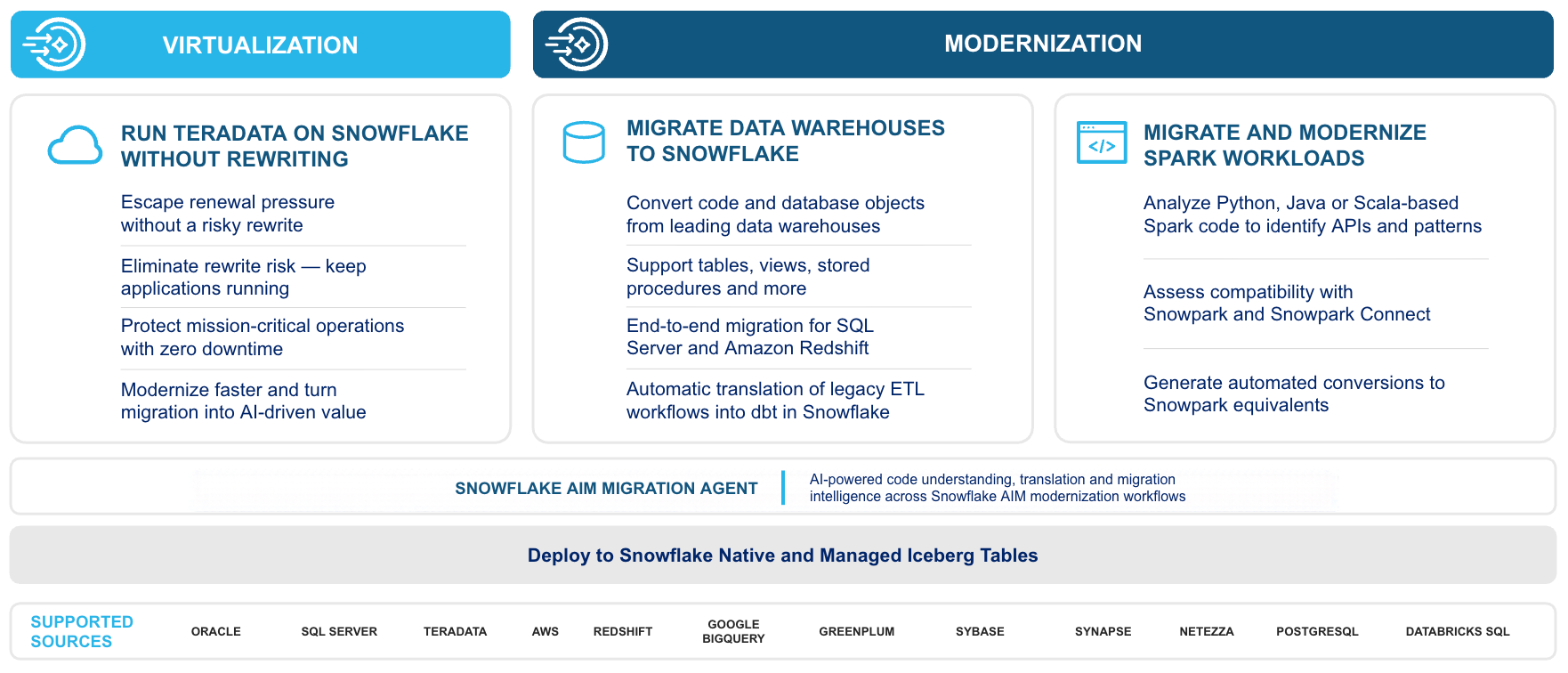
Recognising that different organisations operate under varying contract timelines and architectural mandates, Snowflake AIM supports two distinct paths: Virtualization and Modernization.
Virtualization, powered by the XTRA engine
Virtualization lets organisations run Teradata on Snowflake without a rewrite: zero downtime, no code changes. Applications simply repoint their connection strings to the Snowflake AIM virtualization endpoint, while the XTRA engine translates SQL in real time so results match exactly what Teradata would have returned. It's built for organisations working to an aggressive deadline, such as a looming hardware lease expiry or software renewal, who need to beat the clock before tackling a deeper modernisation.
- Zero downtime, no code changes. Existing client applications, BI tools and ETL pipelines keep running unchanged; only the connection string moves, from Teradata to the Snowflake AIM virtualization endpoint.
- Rapid decommissioning. Organisations can switch off legacy Teradata hardware within months rather than years, beating contract renewal clocks and eliminating hardware maintenance costs immediately. Native code refactoring and pipeline optimisation can then be handled systematically post-migration.
Modernization, powered by the Snowflake AIM Agent for Data Warehouses
Modernization is powered by the Snowflake AIM Agent for Data Warehouses, which drives a full, AI-assisted conversion into native Snowflake and dbt pipelines. It suits organisations seeking a clean-slate, end-to-end rebuild rather than a like-for-like lift onto Snowflake.
- AI-driven wave assessment. AIM analyses months of historical query logs and dependency graphs to automatically categorise assets into logical migration waves, isolating high-impact BI reporting assets into Wave 1, for example.
- Automated code refactoring. Legacy procedural logic, BTEQ scripts and complex stored procedures are automatically translated into clean, modular Snowflake SQL or dbt models.
- Hierarchical multi-level validation. AIM checks data and logic parity across four explicit tiers: schema structure comparison, aggregated metric matching, row-count reconciliation and cell-level floating-point value validation.
The six-stage guided migration lifecycle
Execution within Snowflake AIM is orchestrated by CoCo, the guided agent framework that leads engineering teams through a systematic six-stage migration workflow. CoCo tracks progress across sessions, supports multi-user collaboration, and picks up exactly where the team left off.

- Assessment and wave planning. The agent ingests historical query logs, schema definitions and usage metadata to map system dependencies, flag unsupported functions, and organise objects into prioritised migration waves.
- Deterministic code conversion. Source DDL, DML, view definitions, stored procedures and scripts are parsed through deterministic compilers and translated into native Snowflake SQL and dbt project structures.
- Synthetic and log unit testing. Before production data moves anywhere, AIM generates synthetic test datasets and replays historical production query logs against the converted code to catch edge-case discrepancies early.
- Scalable, high-throughput data migration. High-performance AIM data workers run parallelised data extraction from the source Teradata environment, streaming data directly into Snowflake target tables with end-to-end encryption.
- Hierarchical data validation. Automated validation protocols run across source and target datasets, systematically comparing row counts, column aggregates, hash totals and cell-level data types to confirm data fidelity.
- Native ETL modernisation. In the final phase, legacy orchestration pipelines and middleware jobs are refactored into modern Snowflake-native tasks, Dynamic Tables, or integrated dbt workflows.
Conclusion and practitioner takeaway
Reflecting on the Teradata to Snowflake migration, completed earlier this year, the contrast between traditional migration approaches and Snowflake AIM is stark for the team. Traditional migrations force teams to accept difficult trade-offs between timeline, cost and execution risk.
Snowflake AIM removes those trade-offs. By offering a dual-path strategy, letting teams choose between rapid hardware decommissioning via Virtualization or methodical, clean-slate conversion via Modernization, AIM gives data leaders full control over their modernisation timeline. Backed by a deterministic execution core and AI-guided orchestration, organisations can carry out legacy platform migrations with far greater speed, lower credit overhead, and real technical confidence.
Modernising a legacy data warehouse no longer has to mean taking on months of rework and operational risk. With Snowflake AIM, organisations can de-risk the transition, beat aggressive renewal deadlines, and land on a modern cloud platform efficiently.
Data Domain is a New Zealand data and AI consultancy and Snowflake Premier Partner. Having recently completed a large Teradata to Snowflake migration for a major New Zealand telco, our team brings practitioner-level experience to every legacy modernisation engagement it takes on.
Talk to us today about your legacy platform to Snowflake migration, or discover more about our Data Foundation practice.
General Enquiries
If you are keen to have a chat with an expert or discuss a project, please fill out the form and we'll get in touch.