

%20(20).png)
As an AWS partner, we spent a day at AWS Cloud and AI Day Auckland in September and came away with one thought worth writing down.
For years, conversations with clients who were hesitant about AI followed a familiar shape. Somewhere in the first hour, someone would ask where the data actually lives, and for a lot of New Zealand organisations that question used to end the conversation before it really started. It doesn't end it anymore.
Two customer stories that weren't pilots
Two customer stories from the day stuck with us, because neither one was a pilot dressed up as a success story.
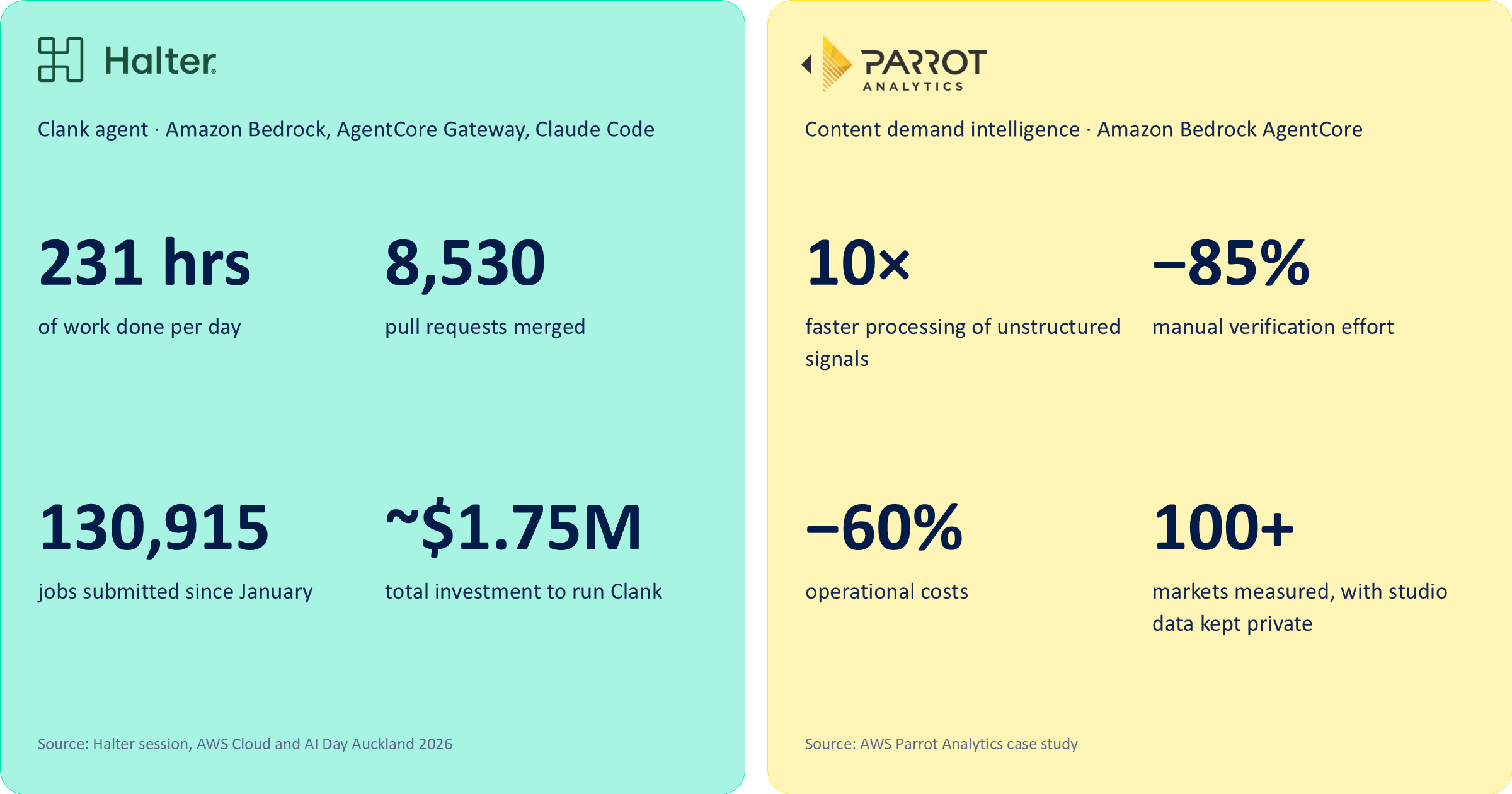
Halter, the Waikato-founded livestock tech company, talked through Clank, an AI agent built on Amazon Bedrock, AgentCore Gateway and Claude Code that now handles incident response and operational support across their platform. Since going live in January, Clank has done the equivalent of 231 hours of work a day, merged 8,530 pull requests and processed more than 130,000 submitted jobs, for roughly $1.75 million all in. Their cloud architect's line stayed with us: there's an animal on the other end of that technology, so it has to be robust.
Parrot Analytics, the Auckland-founded company that measures audience demand for film and TV content across more than a hundred markets, told an equally grounded story. Using Bedrock AgentCore, they've cut processing time on unstructured signal data by ten times, manual verification by 85 percent and operational costs by 60 percent, all while keeping confidential studio data inside a secure environment that's never used to train models. That's the same instinct we hear from clients here, just in a different industry.
Accountability is now a design requirement
Kiwibank's session added a third angle worth sitting with. Their framing was an invisible bank, one you never have to think about until the moment you need it. Their stated approach to AI was to support and amplify human expertise, help teams make better decisions, speed up delivery, and keep humans accountable.
We want to be honest about our reaction to that last point, because it would have been easy to nod along and move on. Accountability named as a design requirement, not a value statement or a footnote, is a real shift in what we're hearing from clients close to financial services. It used to be implicit, something you assumed a vendor or platform handled somewhere upstream. Now it shows up as an explicit requirement in the room when we scope AI work, before anyone talks about models or accuracy. That's a very different starting point from where these conversations began even a year ago.
The sovereignty question finally has an answer
Which brings us back to where we started. The AWS Asia Pacific (New Zealand) region went live just over a year ago: three availability zones, built sovereign by design, backed by a NZ$7.5 billion investment commitment, and running on renewable energy through a partnership with Mercury's Turitea South wind farm. The Prime Minister called it the largest technology investment in New Zealand by an international company, with projections of up to a thousand jobs and a boost to GDP of nearly NZ$11 billion.
Those are the headline numbers, and they're worth knowing. They're not the part that has changed our conversations with clients.
More and more, organisations tell us directly that they're less comfortable having their data hosted outside New Zealand. Not as an abstract compliance position, but as a real, felt preference. That discomfort used to be a dead end for an AI initiative. Now, for the first time, there's an answer that doesn't involve compromising on capability. You can build on Bedrock, run agentic workloads, and keep the data resident in New Zealand the whole time.
The security reason is now managed. With data staying in New Zealand, the AI tooling that was off the table is back on it.
The AWS stack, piece by piece
What excites us is the capability across the AWS architecture stack as a whole, more than any single piece treated as its own launch.
- Kiro is an AI-powered, agentic software development platform and VS Code-compatible IDE built on Amazon Bedrock. It takes work from prototype to production, with property-based testing that checks universal truths across an input space rather than a handful of examples.
- Amazon Quick has grown into a full assistant: research, data analysis, workflow automation and document generation in one place. It sits on infrastructure that's never used to train underlying models and carries the compliance certifications regulated clients ask for.
- AWS DevOps Agent is positioned as a frontier agent for operational excellence, one that learns your environment as you go and gets more relevant over time, echoing exactly what Halter is doing with Clank.
- Amazon Bedrock has nearly doubled its available models over the past year, so the platform choice underneath all of this keeps getting less binary.
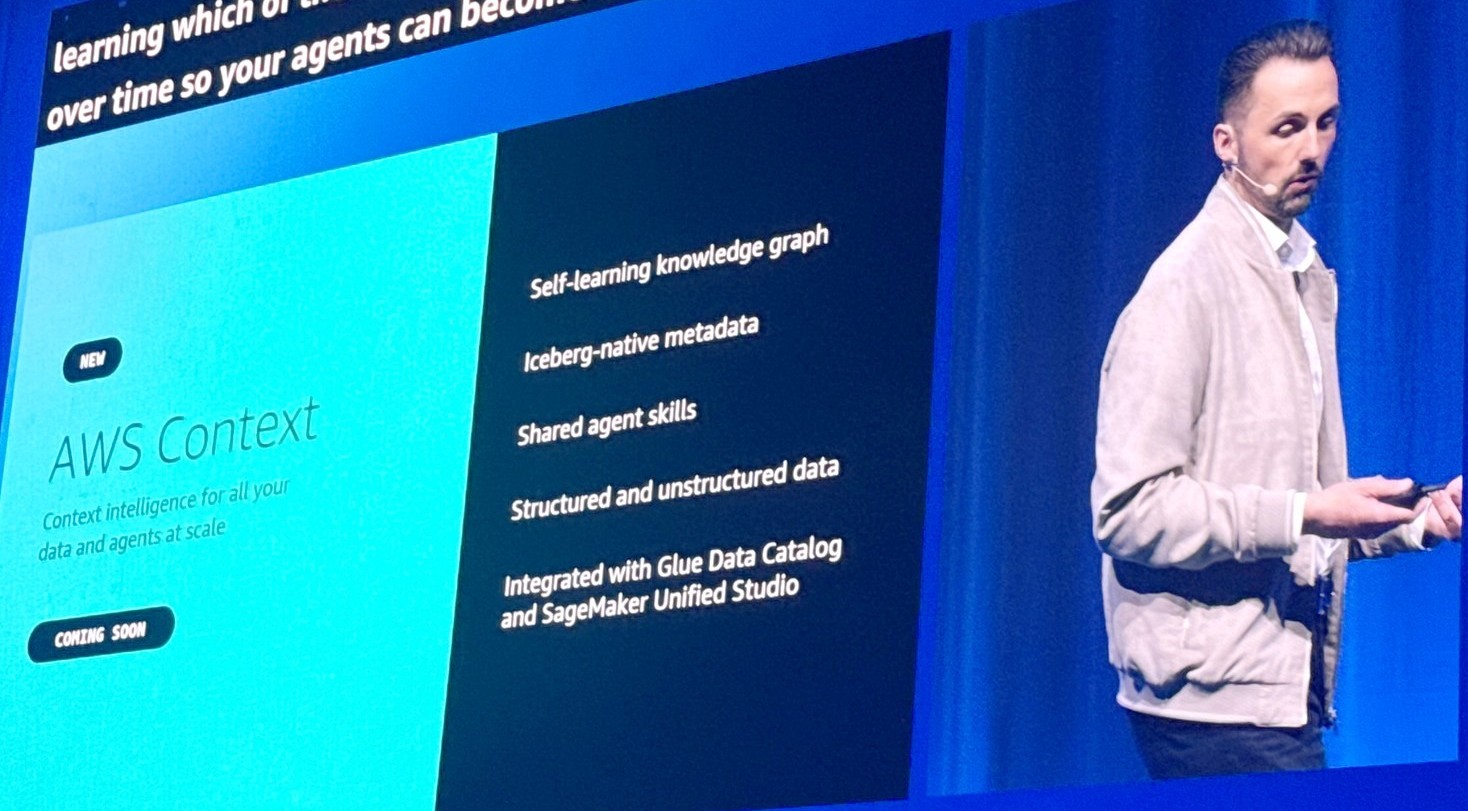
- AWS Context, coming soon, is aimed squarely at context intelligence across an organisation's structured and unstructured data at scale.
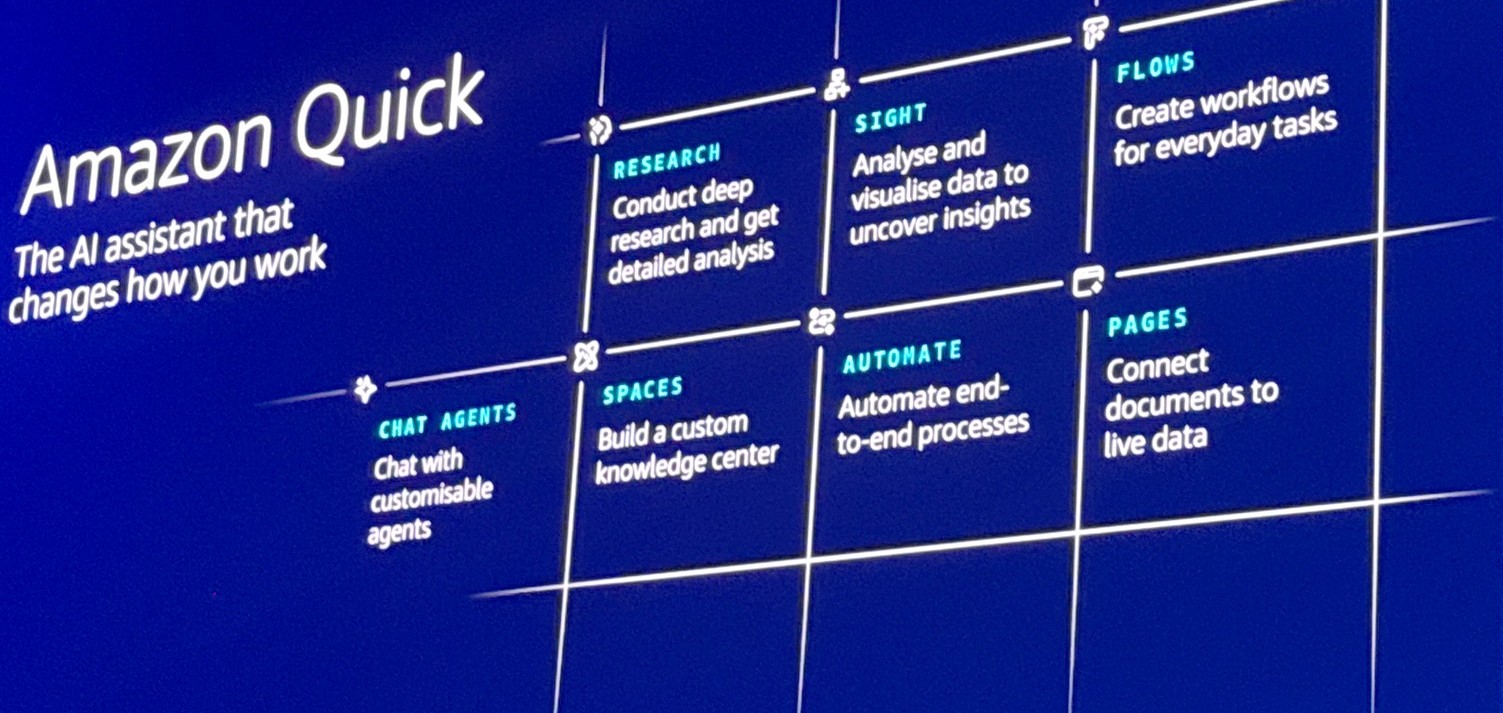
That last one matters more than its "coming soon" tag suggests. It's a direct acknowledgement that the hard part was never the agent. It was always the data underneath it.
Breaking Barriers comes to New Zealand
There was also a session on Breaking Barriers, an AWS hackathon coming to New Zealand for its first local round after running in only a handful of places worldwide. Nonprofit and community organisations bring a real challenge in education, healthcare or climate resilience, AWS matches them with developer teams, and over 72 hours those teams build a working prototype on AWS infrastructure. The winning solution gets dedicated engineering support to take it from prototype into production. It's scheduled for early 2027.
We like the idea. Anything that puts real engineering time and money behind communities trying to solve their own problems is something we're happy to get behind. We'd rather see more of this than none of it.
Where this leaves Snowflake and Databricks
So here's where we land. For most of the clients we work with, Snowflake or Databricks already sits at the core of a rich data estate: the governed layer where data lives, moves and gets modelled before anything downstream touches it. Most of what AWS showed at this event fits around that core rather than competing with it.
Kiro shortens the path from prototype to production. AgentCore and Bedrock give you a place to run agents like Clank against that same data, safely and repeatedly. The DevOps Agent watches how the whole environment behaves and gets more useful the longer it runs. None of it replaces the platform decision. It just makes that platform worth more once it's made.
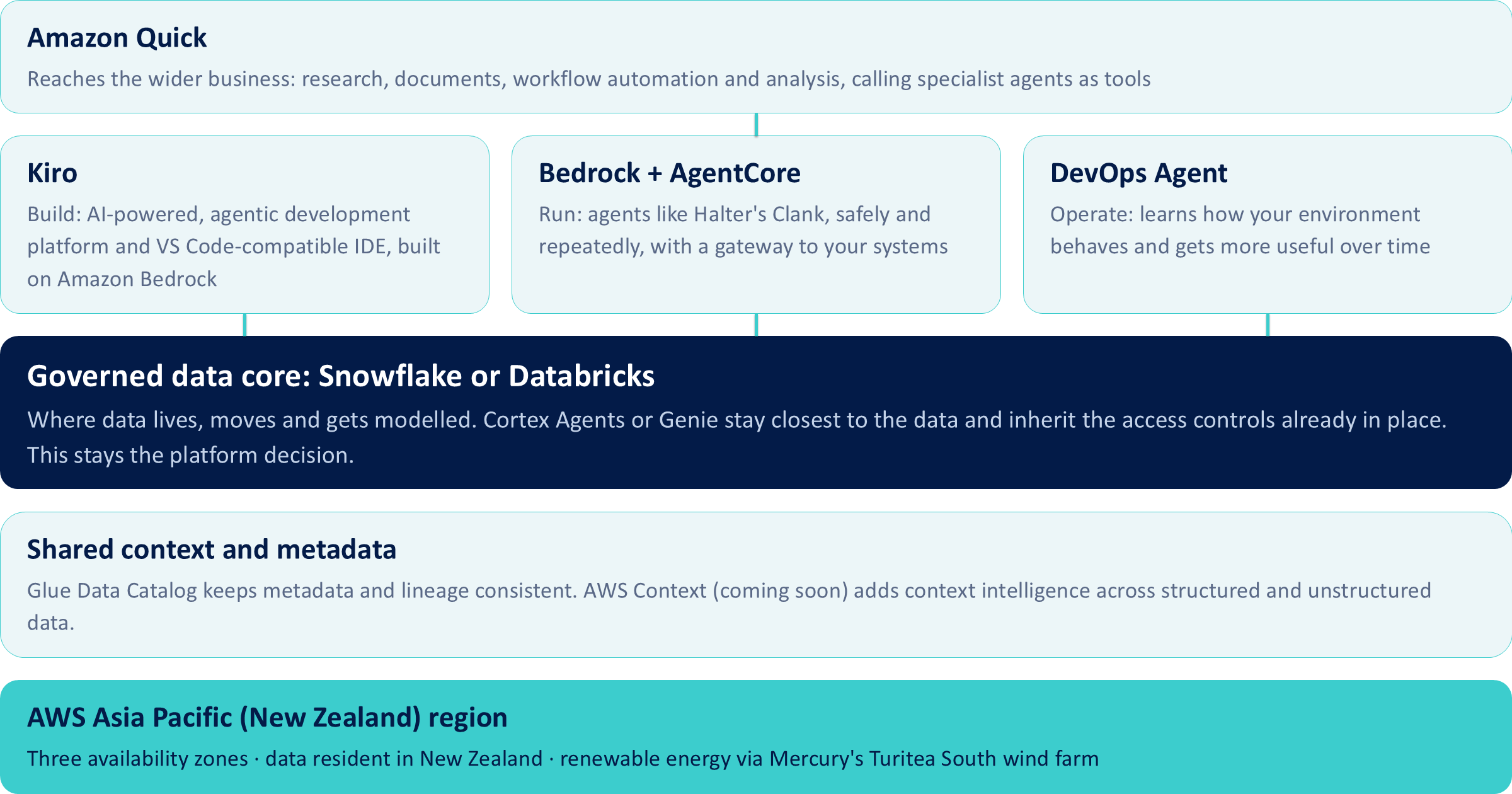
With this much capability arriving on both sides, customers already on Snowflake or Databricks don't need to stop that investment to take advantage of it. The more interesting possibility is an architecture built on, for example, Snowflake and AWS together, which lets an organisation extend its AI capabilities to wherever one platform is better suited to a particular use case.
Snowflake Cortex Agents, or Genie on Databricks, can stay the specialist closest to the governed data, inheriting whatever access controls already sit over it. Amazon Quick then reaches into the parts of the business that sit outside either platform: research, documents, workflow automation and the wider AWS-hosted estate. Pair the two, with Quick calling Cortex Agents or Genie as one capability among several, and the breadth of what an autonomous agent can cover in a single conversation gets much wider than either platform manages alone. It's the same pattern Halter already uses to expose Salesforce and manufacturing data to Clank through AgentCore Gateway.
AWS's quieter bet: the foundational layer
That's also where we think AWS is placing its real bet, on a foundational layer of its own. The Glue Data Catalog is a good example, keeping metadata and lineage consistent across whatever sits on top of it. AWS Context, still coming soon, aims to do the same across structured and unstructured data.
Snowflake and Databricks stand completely on their own here. They're already the foundational layer for a data and AI platform and don't need AWS to get there. What AWS is building sits alongside that, in the parts of an architecture where it makes sense, rather than underneath it. That's a bigger, quieter play than any single agent demo, and it's the one we found most interesting out of the whole day.
Data Domain is a New Zealand data and AI consultancy and an AWS partner, helping organisations across financial services, telecommunications and government build data foundations and put AI into production.
If you're weighing up an AI investment and aren't sure where your own data foundation stands, that's exactly the conversation we'd like to have. Get in touch, or read more about our Data Foundation and Applied Intelligence practices.
General Enquiries
If you are keen to have a chat with an expert or discuss a project, please fill out the form and we'll get in touch.