

There is a particular kind of clarity that only arrives when you are in a room with thousands of people all grappling with the same question: are we doing this right?
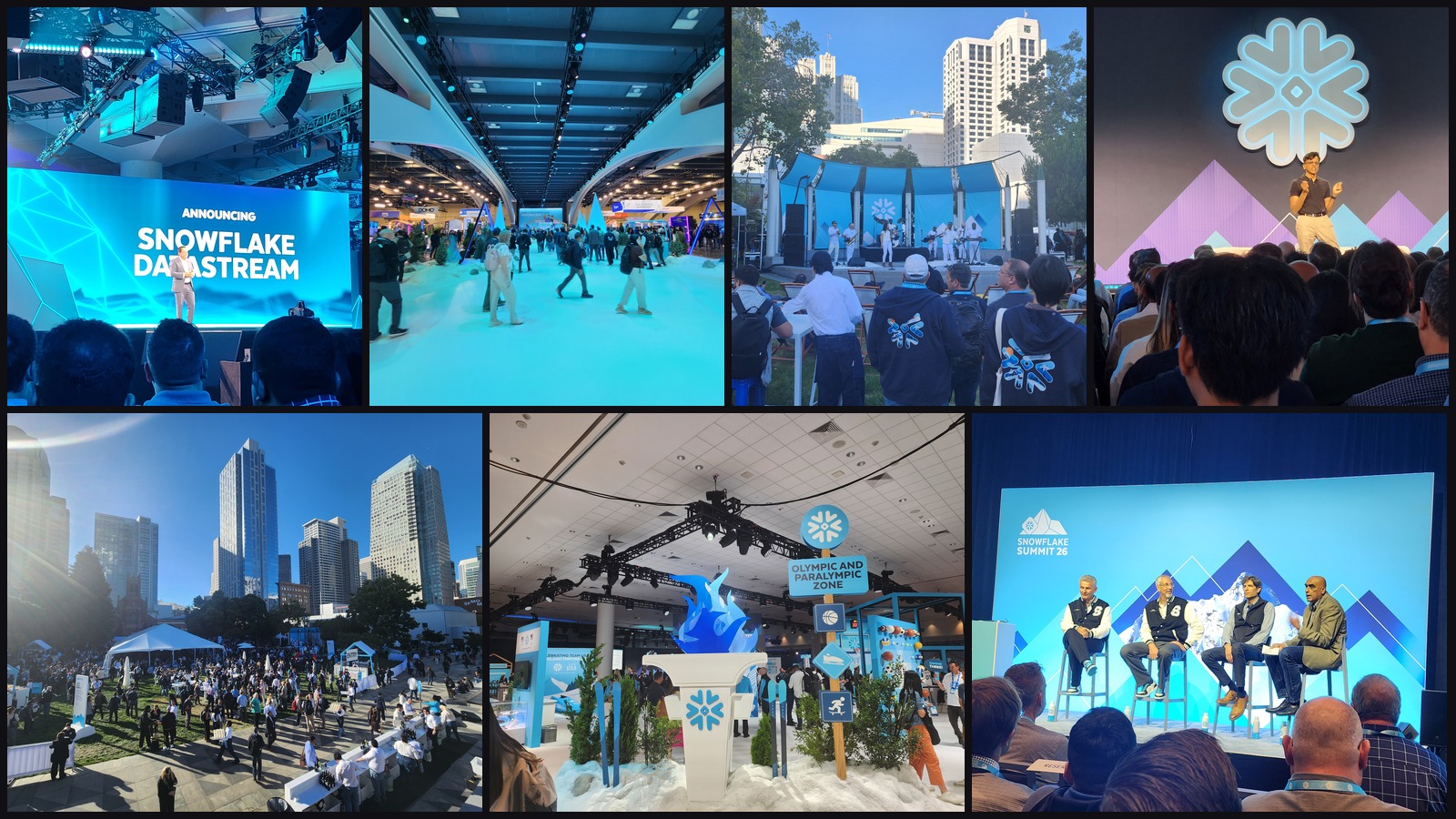
That is the undercurrent that was felt all week at Snowflake Summit '26 in San Francisco. Not anxiety, more like the productive discomfort of an industry collectively taking stock. Twenty thousand attendees. Over 500 sessions. Two major product rebrands. A $6 billion AWS partnership. And a theme, Making AI Real for Business, that for the first time in years actually felt earned rather than aspirational.
Many of the conversations at the Summit resonated. This isn't a product review, nor a conference recap. It's something closer to a reckoning.
The Stat That Reflected Thinking
A CIO took the stage and delivered a number that was worth pondering on: 9,000 people in his organisation built 18,000 AI skills. Five hundred were any good.
This isn't an AI adoption issue. It's a reality of the scale of adoption and reminder of the guardrails required for optimal outcomes.
Five hundred out of eighteen thousand. A 2.7% hit rate on AI capability built at scale. The question worth sitting with is not why so many failed. It is why anyone expected otherwise. We need to hand powerful tools to people with the right architecture, governance, and context to make them effective. Optimising for velocity and deploying thousands of siloed agents isn't transformation.
We Have Been Here Before
The sessions attended had, one after another, circled back to the same theme. This is not the first time we have promised transformation through data.
Think about the lineage. Decision support systems gave way to data warehouses. Data warehouses gave way to BI platforms. BI platforms gave way to data lakes, then data products. And now we are collectively reaching for the Agentic Enterprise, intelligence that does not just inform decisions but acts within workflows autonomously.
At each transition, the core promises were similar: better decisions, faster insights, competitive advantage. And at each transition, the same shadows emerged. Shadow IT. Then Shadow BI. Now Shadow AI, uncontrolled agents proliferating across production environments, built by well-meaning people with access to powerful tools and insufficient guardrails.
What has changed is not the pattern. What has changed is the velocity.
The benefits arrive faster. The risks compound faster. The gap between organisations that built strong foundations and those that did not becomes visible, and consequential, much sooner.
Snowflake co-founder Benoit Dageville made the relationship between data foundations and AI unmistakably clear: data and AI are not separate disciplines. They are inseparable. The shift to the name AI Data Cloud was more than a rebrand; it reflected the reality that meaningful AI depends on a data foundation that is grounded, governed, and trustworthy.
The Five Themes Playing Out In Front of Us
We believe the current data and AI transformation has five themes which were also reflected in the conversations at the Summit throughout the week:
Theme 1: The work beneath the work, gone. AI's first gift to enterprise is removing the mundane barriers that slow human work, intelligent routing, automated workflows, the elimination of low-value repetition. Marketing teams at the Summit described reallocating campaign resources in real-time, collapsing weeks of reporting into hours. Sales teams using AI to synthesise every prior interaction before a client meeting. Agile sprint cycles shortening. The ratio of product managers to engineers shifting.
Theme 2: Power and risk at scale. This is the theme most enterprises are currently navigating, and underestimating. Before AI can operate autonomously, organisations must establish the guardrails. Agent identity and security boundaries that limit exposure. Role-based access controls that actually reflect how people work, not how they were supposed to work five years ago. Governance and Security frameworks built for a world where the entity executing the workflow might not be human. One comment in a session captured it: more time is now spent thinking about RBAC than almost any other architecture decision. That is not a complaint. That is maturity.
Theme 3: Data where it needs to be, not where it ended up. With trust established, data can flow where it is needed. Not hoarded by departments. Not locked in legacy systems. Not duplicated across seventeen copies in different formats. One of the most significant announcements at the Summit was the ability to work on a single, live, governed copy of data wherever it resides, across platforms, external lakes, and open systems, without moving or copying it. That is not a technical footnote. That is the architectural unlock that makes everything else possible.
Theme 4: Not a tool. The terrain. The end state, intelligence woven into every workflow, every decision point, every customer interaction. Not AI as a feature. Not AI as a department. AI as the operating system of the enterprise. Most organisations are somewhere between Themes 1 and 2. A few are glimpsing Theme3. The gap between where leaders think they are and where they actually are is significant.
Theme 5: Benefits vs the explosion of cost. Token spend is not a rounding error. Every agent call, every model invocation, every context window loaded with unstructured data has a price. And unlike traditional software licensing, the cost curve is not linear, it scales with usage, with complexity, and with the sprawl of agents that nobody properly inventoried in the first place. The need to track benefits is more imperative as unchecked AI adoption will outpace the benefits they were meant to provide.
The Application Layer Is Being Consumed
One of the more provocative ideas circulating in conversations at the Summit is that the traditional application layer is under existential pressure. Not from better applications, from agents that can do what applications were always meant to do, without the constraints of a fixed interface.
A CEO at the Summit demonstrated replacing a seven-figure annual SaaS platform with an application built in-house using AI tooling. Another described a data migration that previously took six months completed in six days. A CEO deployed a panel of AI coaches i.e. leadership, technical, personal development agents. These changes have fundamentally transformed how they think about hiring: shifting from skills-based to attribute-based assessment.
AI is not just plugging gaps in software. It is filling gaps in software that should have existed, but where the ROI was never there to justify building it.
The implication for enterprise leaders is significant. The question is no longer whether to adopt AI. The question is how to architect for a world where the agent is not a feature sitting inside your application. It is the interface itself. You need to ship to the app, to the CLI, to wherever the work actually happens. The organisations that assume AI lives in a UI are already behind.
The Skill That Is Appreciating In Value
Here is the counterintuitive insight that is taking shape: in the age of AI, domain expertise is becoming more valuable, not less.
The people building the 2.7% of AI capabilities that actually work are not the best prompt engineers. They are the people who understand the business deeply, who know why a particular dataset is sensitive, which workflows carry regulatory risk, how a process actually runs versus how it is documented. Technical skill is table stakes. Contextual knowledge is the differentiator.
One of the CTOs at a session framed it well: every team, every Slack channel, every agent should have context about the project. The agent is only as good as the quality of understanding baked into it. Foundational engineering knowledge still matters, not to write the code, but to know whether what was built is actually correct.
This has real implications for how organisations hire, how they structure teams, and where they invest in capability development. The gap is rarely in the technology. It is almost always in the judgment about how to apply it. The person that can combine the business context, optimise the prompts they engineer, and critique the output will be the unicorn.
Harder And Easier, At The Same Time
The duality we keep coming back to is this: AI has made some of the most important and historically painful disciplines both harder and easier simultaneously.
Data governance is a perfect example. The need has never been more urgent, uncontrolled agents, sensitive data traversing more systems than ever, regulatory scrutiny increasing. But the tools to address it have also never been more capable. Automated classification, intelligent lineage tracking, semantic governance layers that understand the meaning of data, not just its structure.
The organisations struggling most are not the ones who lack AI ambition. They are the ones who did not do the foundational work and are now trying to retrofit governance onto systems that were never designed for it. That is painful. It is also avoidable, for those who have not yet started, and accelerable for those who have.
What Comes Next
"Generation isn't operation." That line, heard in a session at the Summit, captures where we are better than any product announcement.
The leaders who treat AI as an operational efficiency play, a cost-cutting exercise, a way to do the same things cheaper, will be outpaced by those asking a different question: what becomes possible that was not possible before? That is the generational shift. Not doing the old things faster. Doing things that simply could not be done.
But here is what we would leave any senior leader with who is navigating this: the AI journey rewards those who respected the data journey. If you built thoughtfully on the way here, if you invested in architecture when it was not glamorous, if you took governance seriously, if you built cultures of data literacy, you are standing in front of a compounding return right now.
If you did not, the gap is closeable. But the time to close it is now, not after you have deployed agents into production.
Think beyond what is possible today. It might be possible in six months.
From what if to what's next. The question has always been the same. The stakes just got considerably higher.
General Enquiries
If you are keen to have a chat with an expert or discuss a project, please fill out the form and we'll get in touch.